
The world of application mobile DualMedia has expanded far beyond simple functionality. From social media platforms to advanced productivity tools, mobile apps have become woven into daily life. As demand for better experiences grows, one solution is reshaping the entire field.
Most mobile apps solve one problem. They stream video. They play audio. They display content. Useful, but limiting. Application mobile DualMedia takes a different approach: it handles both audio and visual media simultaneously inside a single, native mobile experience.
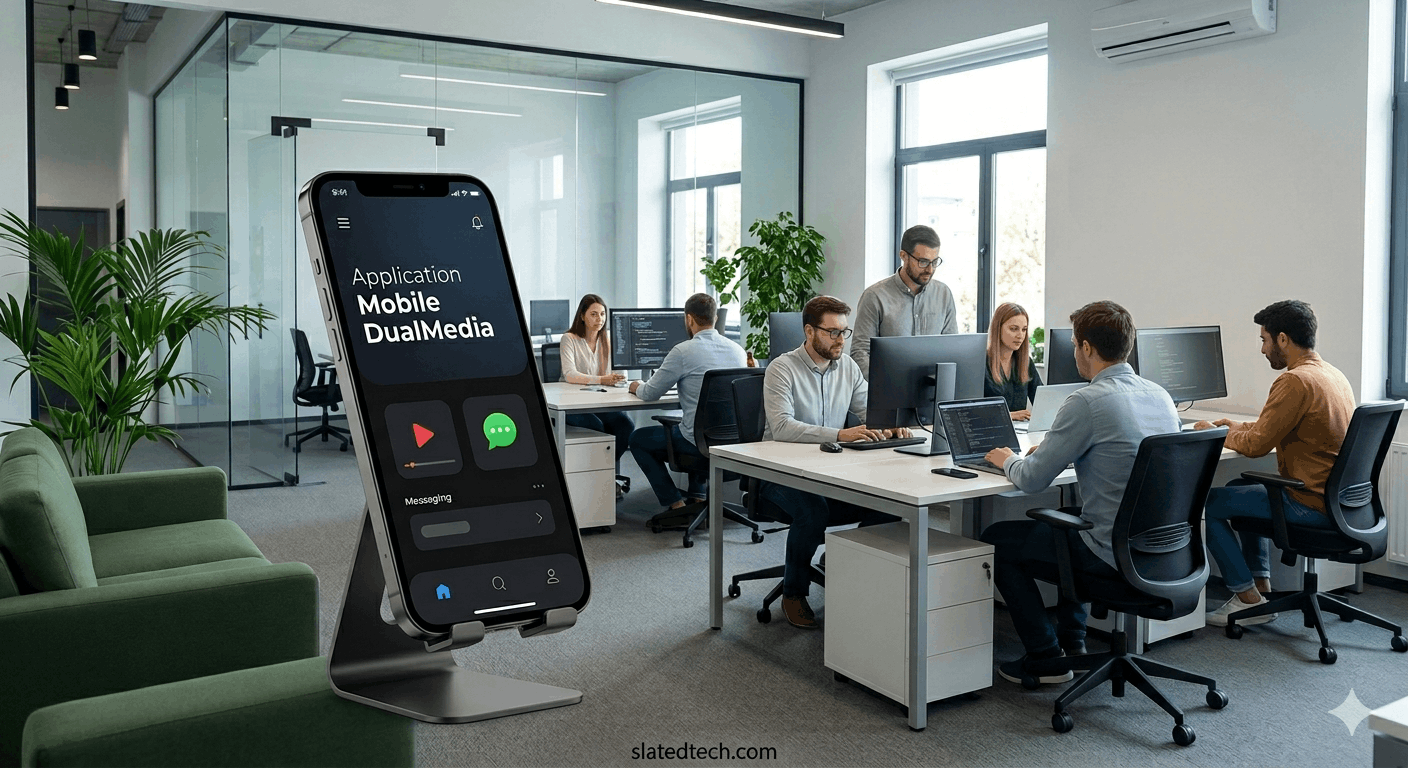
application mobile dualmedia
That distinction matters more than it sounds. Users don’t consume media in isolation. They want to watch a tutorial while annotating a document. They want synchronized audio commentary on a live visual feed. They want rich, layered content that a single-media app can’t deliver.
This guide breaks down what application mobile DualMedia actually is, how it works, where it’s heading, and why developers and users alike are paying close attention.
What is application mobile DualMedia?
Application mobile DualMedia refers to mobile software engineered to process, deliver, and interact with two distinct media streams, audio and visual, in real time. The core idea: both streams are first-class citizens in the app. Neither is an afterthought.
Traditional mobile apps treat media as content delivery. DualMedia treats it as interaction infrastructure. You’re not just watching or listening. You’re navigating, responding, and shaping the experience as it runs.
Early versions appeared in niche sectors, like surgical training platforms overlaying verbal instructions onto live video, or music apps syncing lyrics and notation to playback. Now the architecture is going mainstream.
“DualMedia is what happens when developers stop treating audio and video as separate features and start treating them as one unified experience layer.”
How the technology actually works
At its core, application mobile DualMedia relies on 3 technical capabilities that most older apps don’t have: stream synchronization, adaptive codec switching, and low-latency rendering on constrained hardware.
Stream synchronization
The app maintains a shared clock across both media pipelines. When the audio shifts, the visual layer shifts with it. This sounds simple. On a mobile device with variable network conditions and limited CPU headroom, it’s genuinely hard.
Adaptive codec switching
Good DualMedia apps don’t lock into one compression format. They read network conditions every few seconds and swap codecs mid-session. On a strong 5G connection, you get high-fidelity stereo audio and 1080p video. Drop to a weak signal, and the app degrades gracefully without killing the session.
Low-latency rendering
The real differentiator. Standard media players buffer ahead. Application mobile DualMedia targets sub-150ms end-to-end latency so interactions feel immediate. That’s what makes live commentary, real-time annotations, and synchronized feedback actually work in practice.
Where it’s being used right now
The clearest early adopters are in education and professional training. Platforms like medical simulation software, sports coaching tools, and language learning apps have used DualMedia architecture for a few years.
But the faster-growing segment is consumer entertainment. Application mobile DualMedia now powers a new generation of live sports apps where you get synchronized audio commentary, real-time overlay stats, and a live video feed all in one session. No switching tabs. No losing your place.
Accessibility is another big driver. Dual-stream architecture makes it much easier to deliver audio descriptions alongside visual content, or sign language video alongside spoken audio, in a genuinely native experience rather than a bolted-on accessibility layer.
Comparison table: traditional mobile apps vs. application mobile DualMedia
| Feature | Traditional mobile app | Application mobile DualMedia |
| Simultaneous audio + video streams | No | Yes, native |
| Real-time stream synchronization | No | Yes (<150ms) |
| Adaptive codec switching | Partial | Yes, continuous |
| Interactive overlays on live media | No | Yes |
| Native accessibility dual-track | Add-on only | Built-in |
| Low-bandwidth graceful degradation | Basic | Intelligent |
| Multi-device session handoff | Rare | Yes |
| Developer complexity | Low | Medium-High |
| Typical latency | 500ms+ | 80–150ms |
| Battery impact vs. single-media app | Baseline | +12–18% avg. |
The developer challenge
Building a solid application mobile DualMedia experience is genuinely harder than building a standard media app. The main pain points cluster around 3 areas: memory management, thread coordination, and battery efficiency.
Memory is the obvious one. Running 2 media pipelines simultaneously on a device with constrained RAM means you have to be surgical about buffering. Most teams that get this wrong see crashes on mid-range Android devices running concurrent background tasks.
Battery impact is the sneaky problem. A well-optimized DualMedia app adds roughly 12–18% battery draw compared to a single-stream equivalent. Poorly optimized builds can double that. The teams shipping the best products are the ones who profile continuously, not just before launch.
Thread coordination is where bugs live. Audio and video pipelines need independent threads, but they share a rendering output. Getting that synchronization right under variable CPU load, with background processes competing for resources, is where most development time actually goes.
What’s coming next

mobile dualmedia
Application mobile DualMedia is moving in 2 directions at once: more intelligence and more interactivity.
The intelligence side means AI-driven adaptation. Apps that automatically adjust which media stream takes priority based on what the user is actually engaging with. Watching the screen? The video gets full resources. Locked screen in your pocket? The audio pipeline gets them. This kind of context-aware resource allocation is already in a handful of products and will be standard within a couple of years.
The interactivity side means gesture and voice control becoming first-class inputs. You’ll be able to pause, annotate, rewind, or request an alternate audio track with natural gestures or short voice commands, without breaking the media flow.
5G rollout is the tailwind behind all of it. Higher bandwidth and lower network latency make the hardest parts of application mobile DualMedia much more reliable in real-world conditions.
Also Read: What Is TheStripesBlog Contact Frank
Also Read: Why Use Uhoebeans Software in Business (Guide)
FAQs: application mobile DualMedia
What exactly makes DualMedia different from a regular media app?
A regular media app plays one stream, audio or video, with the other as a secondary add-on. Application mobile DualMedia treats both streams as equals, running on synchronized pipelines with shared timing. The user experience feels cohesive rather than layered.
Is application mobile DualMedia available on both iOS and Android?
Yes. Both platforms have the underlying APIs to support dual-stream media, though implementation differs. iOS’s AVFoundation and Android’s ExoPlayer both provide the low-level tools developers need. The challenge is cross-platform consistency, which frameworks like React Native and Flutter are increasingly addressing.
Does it require a 5G connection?
No. Good DualMedia apps are built to work across network conditions. 5G makes the experience better, especially for high-resolution video streams. But a well-architected application mobile DualMedia product should perform acceptably on 4G LTE and degrade gracefully on weaker connections.
How does DualMedia affect battery life?
Expect roughly 12–18% more battery drain compared to a single-stream app doing equivalent work. Teams that invest in profiling and adaptive resource management can keep this toward the lower end. It’s a real tradeoff, and the best products are transparent about it.
What industries are adopting application mobile DualMedia fastest?
Education, professional training, and live sports are the fastest-moving sectors right now. Healthcare and accessibility tooling are close behind. Consumer entertainment is the biggest long-term market, but it’s also where the competitive pressure is highest.
Is application mobile DualMedia just for live content?
No. The architecture works well for pre-recorded content too. Podcast platforms using DualMedia can sync chapter markers with visual slides. E-learning apps can align audio narration with animated diagrams. The real-time synchronization capability is most visible in live content, but the benefits extend to any scenario where 2 media streams need to work together.
How hard is it for developers to build a DualMedia app?
Harder than a standard media app, honestly. The core challenges are memory management under dual-stream load, thread synchronization between audio and video pipelines, and battery optimization. Teams that have shipped production DualMedia apps typically say the synchronization work alone adds 30–40% to initial development time.
Is it worth building for?
If your product involves media and you care about user experience, probably yes. The bar for mobile media experiences has risen. Users who’ve used a well-built application mobile DualMedia product find single-stream alternatives frustrating in comparison.
The development complexity is real. So is the battery tradeoff. But the user experience delta between a thoughtfully built DualMedia app and a standard media app is wide enough that it’s becoming a competitive advantage in markets where media is the core product.
The teams ignoring application mobile DualMedia today will spend the next few years playing catch-up. The ones building it now are setting the baseline everyone else will have to match.
COMMENTS