
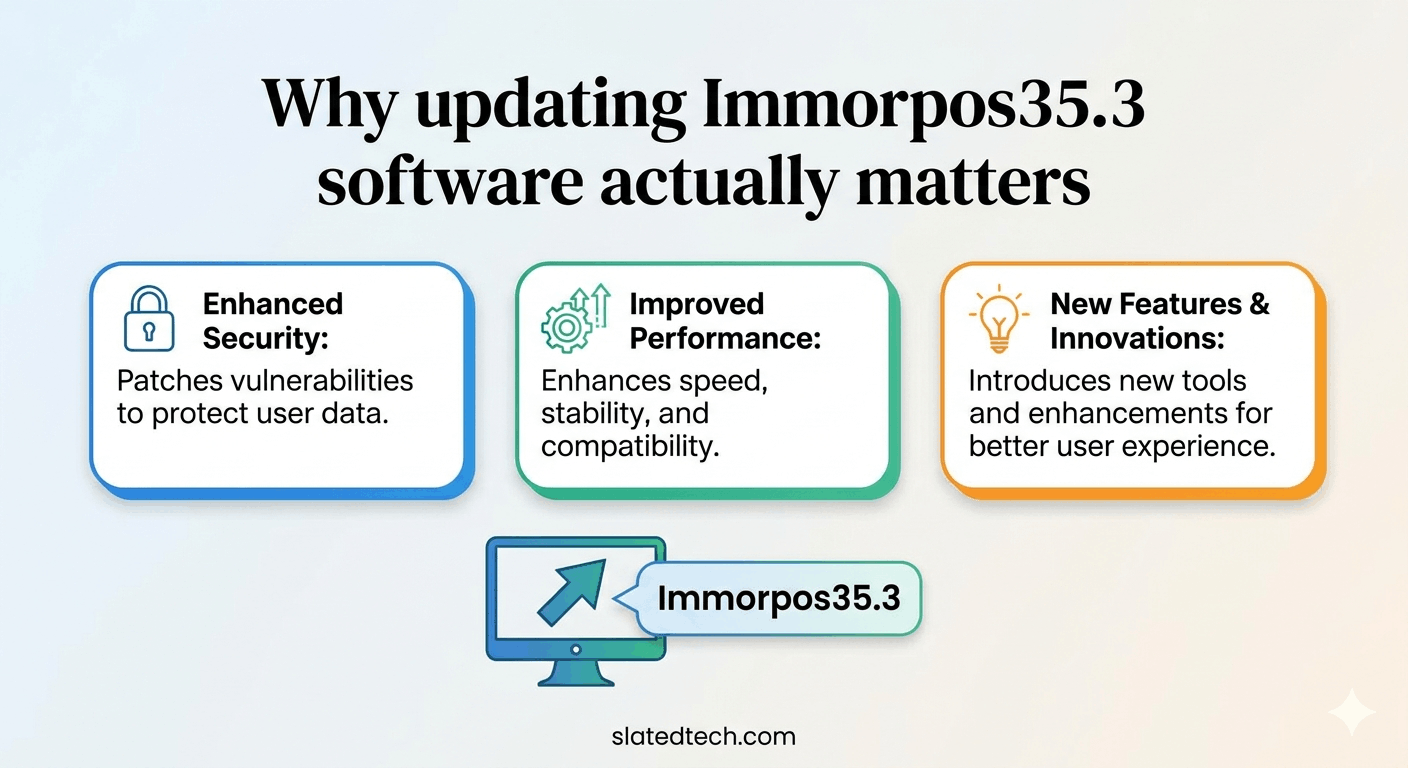
why upgrade immorpos35.3 software regularly
Software updates can feel annoying at times. You’re in the middle of work, a notification pops up, and suddenly your system wants to restart. Many users delay updates for days, or even months, without realizing the risks involved.
That’s exactly why understanding why updating Immorpos35.3 software is important matters more than ever.
I get the resistance. Nobody schedules their day around a software patch. But the gap between “I’ll do it later” and “I should have done it last week” is where most of the real damage happens.
The cost of putting it off
Let’s start with the part people skip past: a delayed update isn’t neutral. It’s not a pause button. It’s a slowly growing pile of risk.
Every version of Immorpos35.3 that ships fixes something. Sometimes it’s a security hole. Sometimes it’s a bug that corrupts a file once every 200 saves. Sometimes it’s a compatibility patch so the software keeps talking to the other tools you depend on.
When you skip an update, you keep all of those problems. You just keep them quietly.
I’ve seen teams run software 6 versions behind. It works fine, right up until it doesn’t. Then they’re not applying one small patch. They’re jumping across 6 versions at once, on a deadline, with no idea which change broke what.
That’s the honest case for why upgrade Immorpos35.3 software regularly: small updates are boring and safe. Big jumps are stressful and risky.
Security is the obvious one
Most updates patch vulnerabilities. Attackers read the same release notes you do. The moment a fix goes public, the unpatched version becomes a published map of exactly where to break in.
Running old software is like changing your locks and then leaving the old keys taped to the door.
Immorpos35.3 handles data. If that data touches customers, payments, or anything regulated, an outdated install isn’t just your problem. It’s a liability you’ve signed your name to. So when upgrading Immorpos35.3 to new software, treat the security patches as non-negotiable, even when the feature changes don’t excite you.
The stuff people forget about
Security gets the headlines, but updates do quieter work too.
Performance. Older builds carry old code paths, including the slow ones. A version released this quarter usually does the same job with less memory and fewer freezes. You stop noticing the lag because it’s just gone.
Compatibility. Your operating system updates. Your browser updates. Your other software updates. If Immorpos35.3 sits still while everything around it moves, things start to break at the seams. A file won’t open. An export fails. An integration goes dark. Regular updates keep the software in step with its neighbors.
Bug fixes. Every release notes file has a list of things that used to go wrong and now don’t. You might not have hit those bugs yet. Updating means you probably never will.
Support. This one bites people late. Vendors stop supporting old versions. Call the help desk about a version from 3 years ago and the answer is often a polite “please update first.” If you ever need real help in a real emergency, being current is what makes that help available.
When upgrading Immorpos35.3 to new software, do it properly
Updating well is more than clicking “install now” and hoping. A few habits make the difference.
Back up first. Before any major version jump, save a copy of your data and settings somewhere safe. Updates rarely go wrong. When they do, a backup turns a disaster into a minor annoyance.
Read the release notes. They’re short and they tell you what changed. Two minutes here saves you an afternoon of confusion later.
Pick your timing. Don’t update 10 minutes before a deadline. Do it at the start of a quiet morning, or end of day, so you have room to check things afterward.
Test the basics after. Open a file. Run an export. Click the things you click every day. Confirm the update did its job before you fully trust it.
Stagger it across a team. If 30 people use Immorpos35.3, update a few first. If something’s off, you’ve caught it small instead of org-wide.
This is the practical answer to why upgrade Immorpos35.3 software regularly. The routine version is calm. The skipped version is a gamble.
A simple way to think about the conversion
When you finally move from an old build to a current one, here’s roughly what changes. This table maps the old behavior against what you actually get after upgrading.
| Area | Old / outdated version | After updating Immorpos35.3 |
| Security patches | Known holes left open | Latest vulnerabilities closed |
| Speed | Slower, heavier on memory | Leaner, fewer freezes |
| Compatibility | Breaks with newer OS and tools | Works alongside current software |
| Bug fixes | Old bugs still present | Documented bugs resolved |
| Vendor support | Limited or unavailable | Full support eligibility |
| Data risk | Higher, especially on big jumps | Lower, incremental and tested |
| Cost of upgrading later | High, stressful, multi-version | Low, routine, predictable |
The pattern is hard to miss. Every row gets better, and the longest row, the cost of waiting, gets worse the longer you wait.
So what’s the actual takeaway
You don’t need to drop everything for every minor patch. But ignoring updates for months is a decision, even when it feels like avoiding one.
Updated software is faster, safer, and less likely to fail you on a bad day. That’s the whole argument. Knowing why updating Immorpos35.3 software is important is really just knowing that small, regular maintenance beats a big emergency every single time.
Next time that notification pops up, maybe don’t click “remind me later” on autopilot. Pick a good moment today. Then get back to work on a system you can actually trust.
Also Read: Tportstick Gaming Trends From ThePortableGamer
FAQs
How often should I update Immorpos35.3?
Install security patches as soon as they’re stable. For larger feature updates, a monthly or quarterly check is plenty for most users. The point of why upgrade Immorpos35.3 software regularly is consistency, not speed.
Will updating delete my data or settings?
It shouldn’t. Updates are built to preserve your data. That said, back up before any major version jump anyway. It costs you 5 minutes and removes the worst-case scenario entirely.
What if the update breaks something I rely on?
Read the release notes first so you know what changed, and test your core tasks right after updating. If something’s wrong, most versions let you roll back, and your backup covers the rest.
Is it safe to skip a few versions and jump straight to the newest one?
You can, but it’s the riskier path. When upgrading Immorpos35.3 to new software across several versions at once, more changes land together, so problems are harder to trace. Smaller, regular updates are easier to manage.
The software works fine. Why update at all?
“Works fine” usually means “no visible problems yet.” Security gaps and compatibility issues are invisible right up until they aren’t. Updating is how you stay ahead of the problem instead of reacting to it.
Should a whole team update at the same time?
Stagger it. Update a few people first, confirm things look good, then roll it out to everyone. If there’s an issue, you’ve found it small.
COMMENTS